
On October 25, it was reported that Northvolt, Europe’s “biggest battery company”, has officially sent invitations to a number of investment banks to participate in IPO transactions. The company’s current valuation may be close to US$20 billion (approximately 146.3 billion yuan), and it is considering completing its long-prepared IPO in the Swedish securities market.
As a comparison, Sunwanda Power, one of the top 10 global power battery shipments planned for IPO, has a latest valuation of RMB 35.56 billion, less than a quarter of Northvolt.
According to the data, Northvolt was founded in October 2016 and is headquartered in Stockholm, Sweden. Its main business covers the manufacturing of power batteries, as well as the production and recycling of battery cathode materials. It is the first company in Europe to specialize in the research, development and manufacturing of lithium-ion battery technology for electric vehicles.
Northvolt has been sought after by capital since its establishment: in January 2017, Northvolt, which was only three months old, received its first financing of 12 million euros; in September 2017, it received US$15.01 million in early-stage venture capital; in October 2017, it received US$12 million in early-stage venture capital.
In March 2018, Northvolt received 10 million euros in financing from Scania and ABB Technology Ventures; in February 2018, it received 18 million U.S. dollars in subsidy funds from Sweden; in April 2018, it received a 52 million euro loan from the European Investment Bank EIB; in May of that year, it received a 10 million euro investment from Siemens Venture Capital.
In January 2019, Northvolt carried out a Pre-A round of financing of 119.31 million euros; in June, it carried out a Series A round of financing with a financing amount of US$1.015 billion. The main investor was the Volkswagen Group.
From 2020 to 2023, Series B, Series B+, Series C, Series D, and Series E financing will follow one after another, as shown in the figure below:
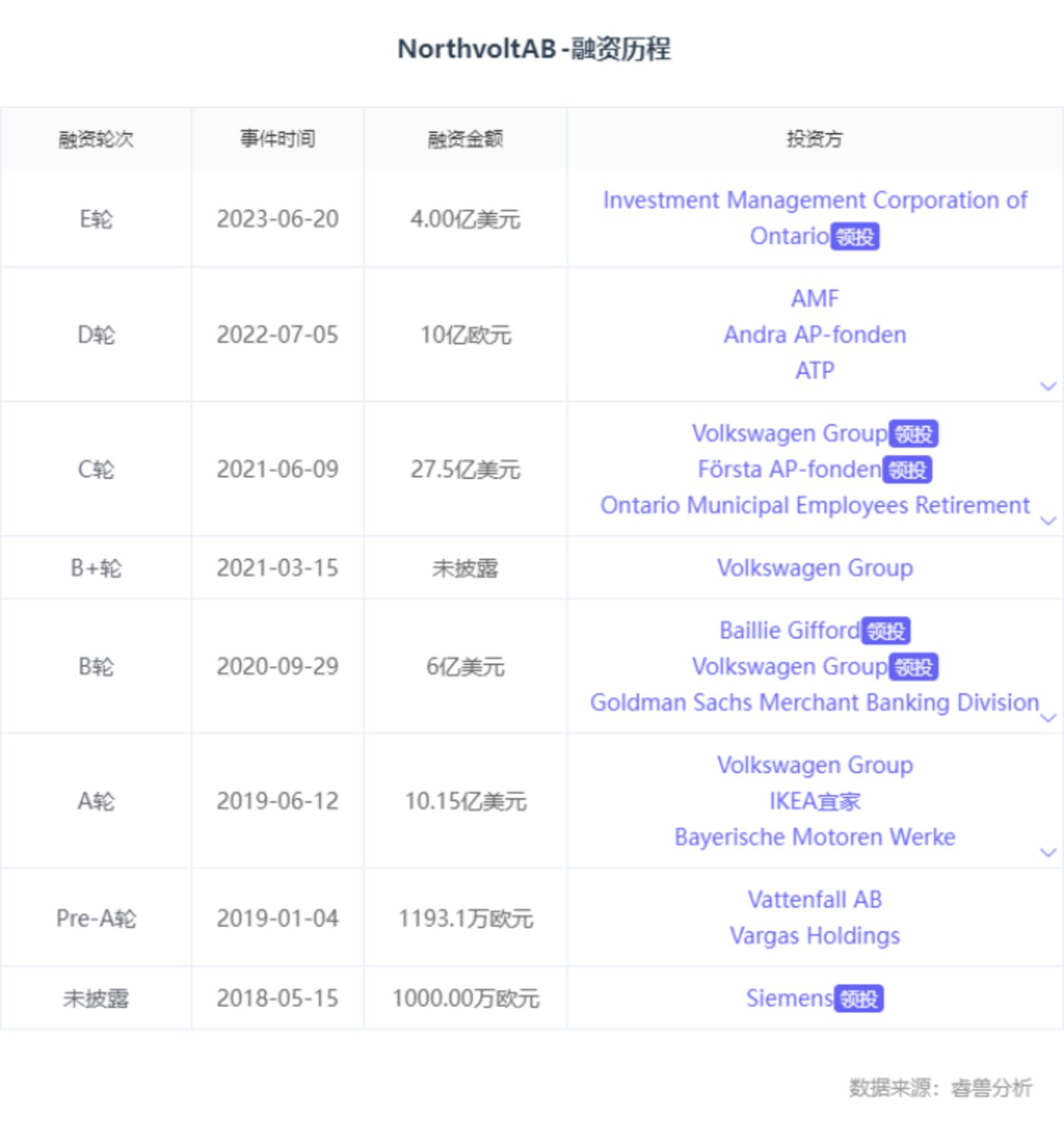
As can be seen from the picture above, Northvolt’s financing, in addition to Volkswagen’s 4 consecutive rounds of investment (at least 2 rounds of lead investment), also received investment from Goldman Sachs, Baillie Gifford, IKEA, ABB, Siemens, and similar investments from multiple European pension funds (ATP, AMF, etc.).
In addition to investment from companies and institutions, a spokesman for the European Union Energy Agency once said that Europe has lagged behind in terms of batteries. "Before a larger battery gap comes, the whole of Europe must cooperate in the supply chain and establish local European battery companies."
In other words, “The whole of Europe is betting on Northvolt, and Northvolt assumes the mission of the European battery industry against Asian rivals.”
Northvolt is building factories on a large scale.
Northvolt plans to produce 16GWh of lithium-ion batteries annually in the initial stage of its operation, and will later reach more than 40GWh.
With the vigorous development of the new energy vehicle industry, Northvolt has further expanded its planned production capacity: its goal is to achieve a battery production capacity of approximately 150GWh by 2030 and occupy 25% of the market share in Europe, which is equivalent to the batteries of 2 million Tesla cars.
But this is still not enough.
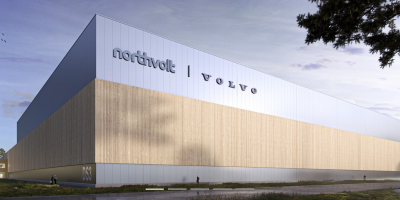
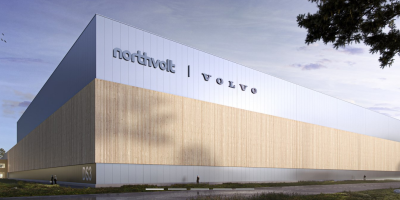
Subsequently, Northvolt announced that it would jointly build a battery factory with Volvo, located in Sweden; it also announced plans to build factories in Germany and Poland, as well as build a second Swedish super factory. In addition to battery factories, Northvolt also has plans to build multiple research facilities and battery recycling facilities.
At the end of September, Northvolt announced that its first North American battery factory would be located in Montreal, Canada. Of the initial $5 billion investment, Northvolt will contribute $3.2 billion, while the Canadian federal government and local governments will each contribute $1 billion.
It is reported that the first phase of construction of Northvolt's Canadian factory will start within the year and is expected to be put into operation in 2026. The initial production capacity will be 30GWh, and the final planned production capacity will be doubled to 60GWh/year, which is almost enough to produce 1 million electric vehicles.
Assuming that Northvolt's officially announced battery factory construction plan is fully implemented, in many years Northvolt will have huge power battery production capacity in Sweden (160GWh + Volvo joint venture factory 50GWh), Germany (60GWh), Poland (12GWh) and Canada (60GWh), corresponding to the annual supply of nearly 7 million electric vehicles.
Supporting Northvolt's rapid expansion of production, in addition to financial support, there are also orders.
It is understood that car manufacturers including Volkswagen, Volvo, BMW and other car manufacturers have placed orders of more than 50 billion euros with Northvolt.
Insufficient product delivery capabilities
Although Northvolt has been developing for 7 years and holds large orders, its shortcomings in the lithium battery market with "many experts" are also obvious, that is, insufficient delivery capacity.
Recently, news showed that BMW was bidding for a 160GWh battery order, which was awarded to Chinese companies such as Honeycomb Energy, CATL, and Everview Lithium Energy.
The market believes that Northvolt must have been considered for BMW's orders. After all, two years ago, BMW signed a long-term power battery supply contract with Northvolt worth 2 billion euros.
The reality is that it was not until May 2022 that Northvolt supplied battery products to an undisclosed car manufacturer, becoming the first European battery company to achieve commercial delivery.
The size of this delivery was not disclosed.
So far, Northvolt has not disclosed battery installation data. Industry organizations, including SNE Research, have never included Northvolt's name in the battery installed capacity lists released.
The last thing I want to say is that although it is about to IPO, the future of Northvolt still needs to be observed.


 +86 155 8855 8073 (Macro)
 18D, Century Haoting Building, Futian, Shenzhen
No. 10-1, Hebin West Road, Muzhou Town, Xinhui District, Jiangmen City
Copyright © 2025 Jiangmen New Energy Technology Co., Ltd Powered by sznbone


 CN
CN